
North Charleston City Directory Holdings
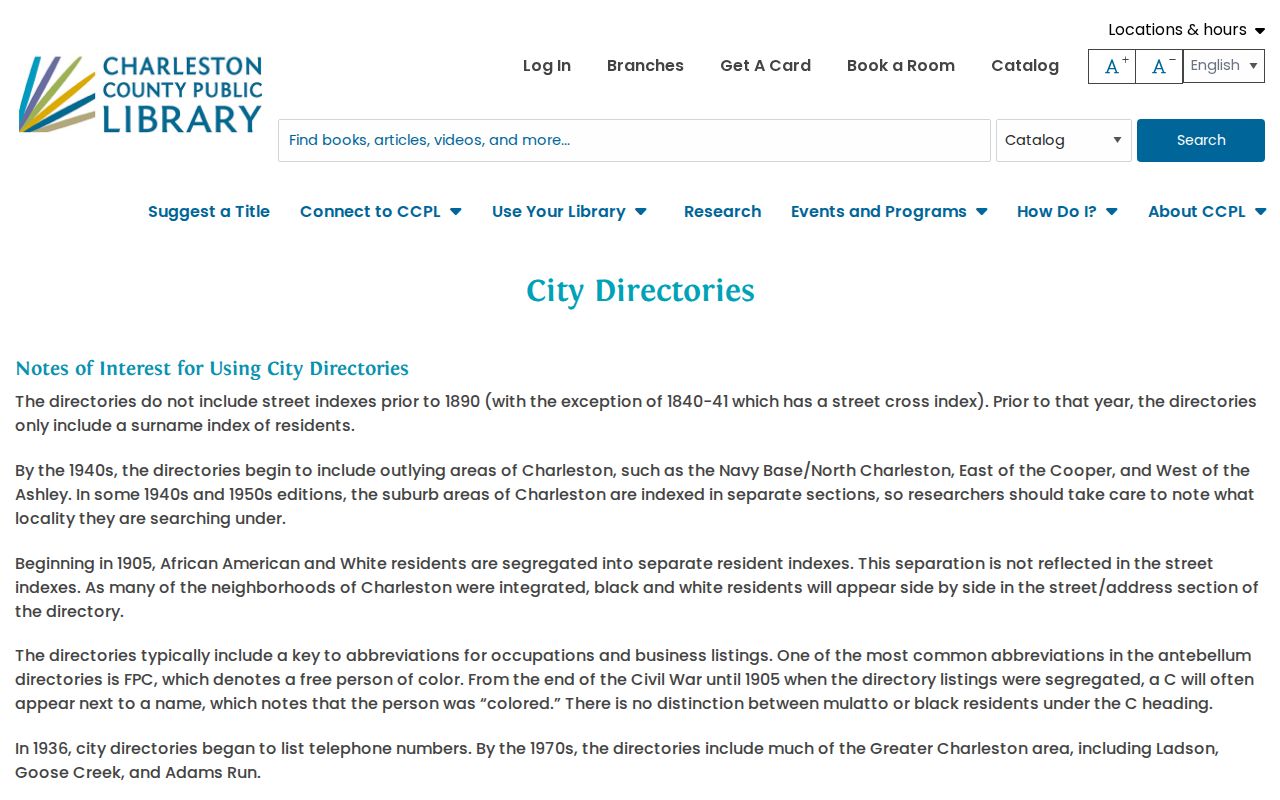
The Charleston County Public Library, or CCPL, is the main local keeper for historical directory work connected to North Charleston. Its collection begins with early Charleston material and expands through microfiche, online HeritageQuest access, microfilm, and original printed books. North Charleston did not incorporate until 1972. The library notes that Navy Base and North Charleston coverage appears in outlying sections by the 1940s, and some 1940s and 1950s volumes use separate suburban sections. Greater Charleston coverage was broader by the 1970s. Choose the locality section in each volume before treating an absence as a negative result.
| Collection | Years | Where Held | Access |
|---|---|---|---|
| Charleston abstracts and microfiche | 1735 and selected years from 1782 through 1860 | CCPL collection | Holdings guide, books, and microfiche |
| HeritageQuest directory run | 1830, 1859, 1866 to 1884, 1886 to 1925, 1927 to 1932, 1934 | CCPL | Online access through the library |
| Microfilm directory run | 1866 through 1932, with documented gaps | South Carolina Room | Onsite historic research |
| Original printed books | 1934 through present, with exceptions in 1995 and 2002 | CCPL | Later Greater Charleston coverage |
| Reverse and street listings | 1840, then 1890 onward | CCPL historic-property resources | Address-to-listed-occupant research |
The library’s city-directory holdings are a finding aid, not a single-name public database. A particular digital volume can require library credentials, while microfilm and original books may require a visit. The listed ranges also contain gaps. Use the specific year list rather than assuming every annual issue exists.
A view of the CCPL city-directory holdings shows the collection formats and year-run organization used for North Charleston historical research.
That mix of formats matters when a household falls between an online volume and an onsite run.
North Charleston Directory Place Names
Historic North Charleston research starts with geography. The present city is spread across Charleston, Berkeley, and Dorchester counties, and earlier material may use Charleston County, Charleston Neck, St. Philip Parish, St. James Goose Creek Parish, Navy Yard, Navy Base, or a settlement name instead of North Charleston. North Charleston began as a 1912 development name near the Cooper River and Navy Yard, then became an incorporated city in 1972. Those labels are not interchangeable filing terms.
Park Circle supplies a useful local example. CCPL describes its circular core as the surviving center of the earlier Pinewood Park plan. Liberty Hill has its own documented history as a post-emancipation Black community established in 1871. When a surname search fails under a current city label, try a relevant historic locality and compare the street, parish, county, map, and directory context. A modern ZIP code is a delivery tool, not a substitute for the historic record geography.
The City of North Charleston identifies the present municipal context, while the library and county collections preserve many earlier labels.
Use the city label as a starting point, then let the date and source determine the historic name to search.
Reading North Charleston Directory Entries
A printed directory is an alphabetic resident and business list, not a complete census of everyone in town. CCPL says a personal entry may include a name, residence address, occupation abbreviation, a business clue, a spouse or widow notation, and, beginning in 1936, a telephone number. The available fields changed over time. Read each entry as evidence for that volume and year, rather than proof that every fact remained true after publication.
| Entry part | What it may tell you |
|---|---|
| Name and initials | The spelling and form used by the publisher, useful for comparing nearby years. |
| Residence | A street address or residence notation that can be compared with a census or reverse listing. |
| Occupation abbreviation | A short code or business clue. CCPL gives examples such as CLK and LAB, so photograph the volume’s key. |
| Spouse or widow notation | A family relationship clue that can help distinguish people with the same name. |
| Telephone number | A field that may appear in volumes from 1936 onward, not a universal earlier field. |
- Criss-cross directory
- A reverse section arranged by street and house number, then the listed occupant or occupants.
- Householder index
- An index designed to lead from a household name to the entry, often with less detail than a full listing.
- Abbreviation key
- The publisher’s list of shortened terms. It is needed to read occupation and business notations correctly.
CCPL’s directory catalog helps identify the named Charleston run and its publisher dates before requesting a volume.
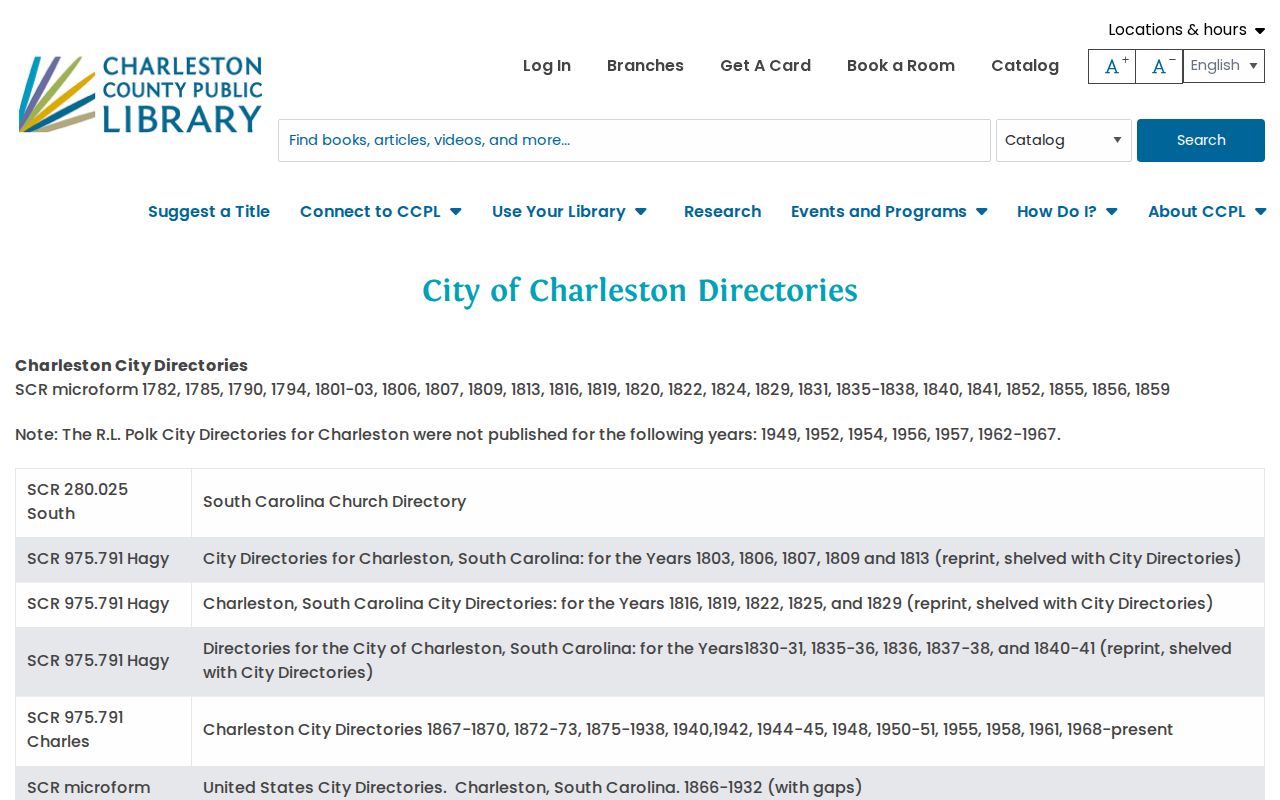
Confirm the year and format before copying a name, because later books and earlier microfilm do not carry the same fields.
North Charleston Directory Years and Gaps
The R.L. Polk run held by CCPL reaches from 1867 through 1938, then resumes in selected later years through the present. The documented missing issues are 1949, 1952, 1954, 1956 to 1957, and 1962 to 1967. A household cannot appear in a volume that was never printed or is not held. Record the exact volume date before deciding whether a name disappeared from the historical trail.
Directories also changed their geographic reach. Outlying Navy Base and North Charleston material appears by the 1940s, sometimes in a separate suburban sequence. Searchers working with a 1940s or 1950s address should inspect the main alphabetical pages and the relevant suburb section. By the 1970s, Greater Charleston coverage included much of the surrounding area, including Ladson and Goose Creek. Coverage expansion is not evidence that an earlier North Charleston household belonged in the main Charleston sequence.
Note: A missing name can reflect a move, death, service, abbreviated spelling, omission, publication gap, or a change in coverage.
North Charleston Reverse Directory Routes
For an address question, the reverse-directory route is more useful than a surname-only search. CCPL documents an exceptional street cross-index in the 1840 volume and street or reverse listings from 1890 onward. Start with the exact house number and street if the volume has a street section. Write down the target address and adjoining listed names, then return to the alphabetic section for initials, spouse clues, and abbreviations.
Older address work needs restraint. CCPL documents several early renumberings and an 1884 to 1886 renumbering project for peninsular Charleston. That source does not establish a citywide North Charleston renumbering. North Charleston incorporation came much later, and older sources may use Navy Yard, Charleston Neck, parish, or county descriptions. Compare a legal description, plat, historic map, and neighboring directory entries before connecting a historic number to a current parcel.
The CCPL historic-property guide identifies reverse lists, maps, tax books, and other sources that can test an address match.
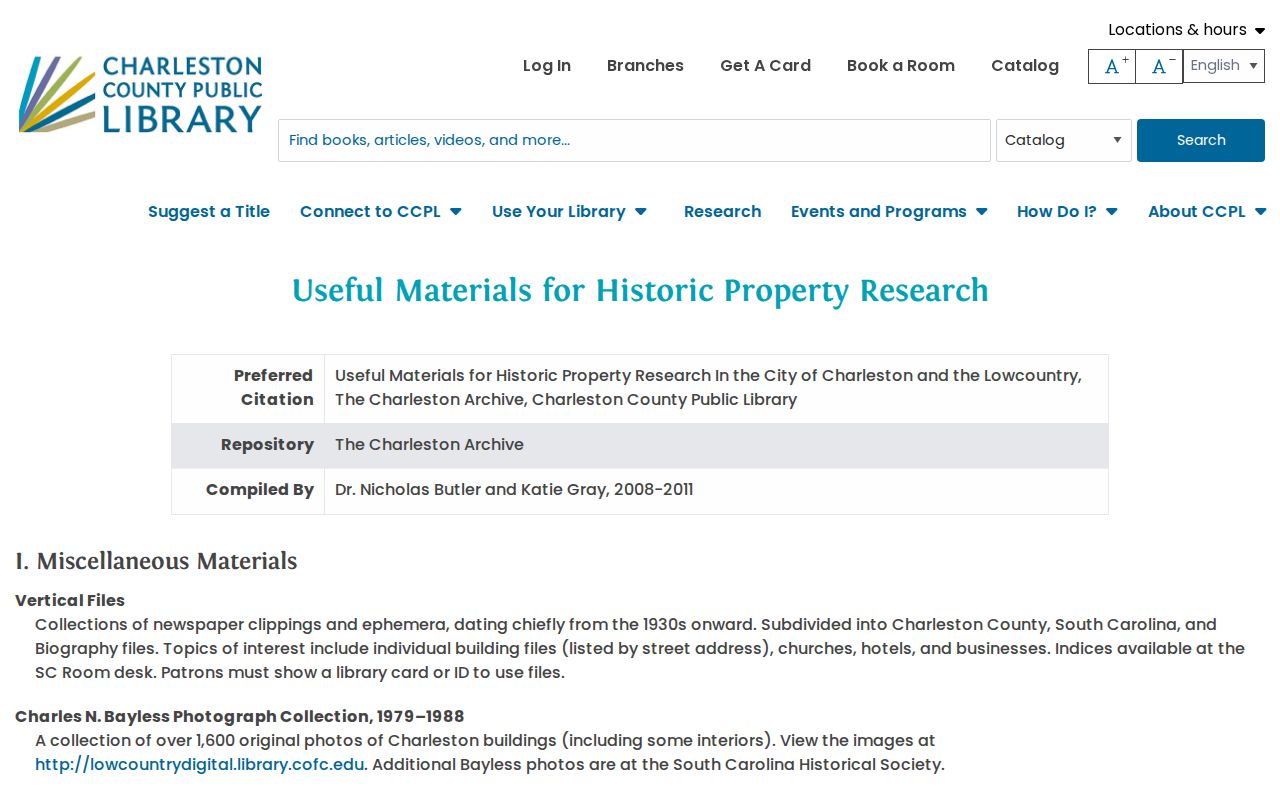
The guide supports a careful address trail without treating a street number alone as a permanent identity.
Tracing North Charleston Directory Families
The volumes work best as a sequence. Begin with the surname spelling found in one volume and capture the address, initials, spouse notation, and other visible details. Check the adjacent available years rather than jumping across a long gap. A move can become visible through a changed residence, while a stable address can help distinguish two people with the same name.
- Find the household in one documented directory year and copy the entry exactly as printed.
- Check the next available year in both the main index and a North Charleston or Navy Base section when applicable.
- Use the reverse listing, when available, to compare the address with listed neighbors.
- Pair the nearest directory years with a federal census. Census records from 1850 onward name household members, while a directory can supply an interim street address.
- Test a later gap with CCPL obituary, probate, land, or map sources instead of assuming the person left the area.
CCPL warns that historic resident listings were segregated from 1905 and used a period racial notation in certain eras. That is a historical indexing condition, not a description to reproduce. Inspect the relevant index sections and the street index, which was not separated in the same way, before ruling out a household.
North Charleston Records Before 1972
The 1972 incorporation date is a practical search boundary, not the beginning of local residents or property. A person tied to a present-day North Charleston address may appear under Charleston, Charleston County, Navy Yard, Navy Base, parish, or an earlier subdivision. CCPL’s directory expansion in the 1940s gives a useful starting point for North Charleston-era families, but it does not move older material into a modern municipal heading.
Charleston County Register of Deeds books add another layer. The office documents paper deed books from 1719 to 1960, physical access for those years, and film or microfiche for 1960 to 2005. Its online index begins in 1978 and images begin in February 1997. That difference explains why a directory address can lead to a library shelf or county counter instead of a searchable modern image. The document trail may require the parcel’s county, legal description, and book or page reference.
For a current address-keyed property route, use the North Charleston street directory lookup after the historic household work identifies a possible property connection.
North Charleston Directory Research Access
The South Carolina Room is a noncirculating research collection, and the Charleston Archive is closed-stack. An appointment helps staff prepare the right directory, map, clipping, historic-property, or microfilm call numbers. Give the year, street spelling, surname variants, and the historic locality label when requesting help. This is especially useful for a North Charleston address that crosses from a current city label into older Charleston or parish filing language.
The Charleston Archive holds public-history manuscripts, rare books, and visual material, with many copies or microfilms available through the South Carolina Room. CCPL’s genealogy resources also organize guides for city, land, life, death, and war records. Those channels provide a documented fallback when a digital directory run ends.
Bring the exact volume year and place-name variants so staff can match the request to the correct collection.
Note: A directory entry is historical evidence for a printed year, so compare it with a census, map, deed, or other contemporaneous source.