
North Charleston Resident Lookup Record Routes
Use the record that answers the actual question. A Charleston County property card can show a recorded owner, the parcel's situs and mailing addresses, and a transfer clue. It cannot establish every person living there. A court index can connect a party name to a case and its dates. A vital-record channel can document an event only within South Carolina's access rules. These differences are important when a North Charleston name appears in more than one county system.
| Record route | Question it can answer | North Charleston channel | Access boundary |
|---|---|---|---|
| Property card | Recorded owner, parcel, situs and tax mailing data | Charleston County Property Record Cards | One parcel at a time; ownership is not household proof. |
| Court index | Case number, party role, filing and event trail | Charleston County Public Index | Confidential and sealed categories remain unavailable. |
| Voter record | Personal registration status and civic geography | South Carolina voter portal | Individual route and protected-data rules apply. |
| Vital record | Birth, death, marriage or divorce event | South Carolina DPH Vital Records | Eligibility and historical-release rules control copies. |
| Estate file | Public probate filings and a named representative | County Probate Court for the correct county | Some case categories are protected. |
First establish the county for an address. North Charleston has territory in Charleston, Berkeley, and Dorchester Counties. A city mailing label alone does not select the assessor, Register of Deeds, Probate Court, or court system. If only a name is known, begin with a county-supported record only after there is a reason to connect that name to the county.
Note: A mailing address on a tax card identifies where a notice went, not a confirmed present residence.
North Charleston Court Names and Dockets
The Charleston County Public Index is the documented state-court route for a Charleston County name. Its Circuit and Family Court paths use a case number or party name, with court category and case type as narrowing context. Read the party role, associated date, case type, and action chronology. Similar names alone are weak evidence. Common Pleas records are online from 1989, and General Sessions and Family Court filings are online from 1992, subject to the limits stated by the Clerk.
| Public Index field | How to read it |
|---|---|
| Court or category | Selects the Circuit or Family path and its coverage. |
| Case number | The strongest identifier when requesting a particular file. |
| Party name | Use spelling variants, then check role and date before matching. |
| Case type | An optional narrowing control; the dynamic option list was not captured. |
| Action detail | Shows case activity rather than a bare name result. |
North Charleston Municipal Court is different. Its public portal is for an identified ticket, summons, warrant, or parking matter. Traffic and criminal retrieval requires a ticket, courtesy-summons, or warrant number with a driver-license number and date of birth; parking uses the ticket number or plate information. It is not a general name browser. Tickets may take up to 72 hours to appear, and a payment does not remove a mandatory appearance.
For an identified Charleston County file, the Clerk also offers counter and request channels. Common Pleas and General Sessions are at 100 Broad Street, Suite 106, and Family Court is in Suite 143. Documents and exhibits are generally viewable on request during normal hours. Mail or in-person requests should include the case number and parties. Staff can retrieve a public file but cannot decide whether a name match is the person sought.
North Charleston Municipal Court's official public-portal screen shows the identified-matter route for a careful record check.
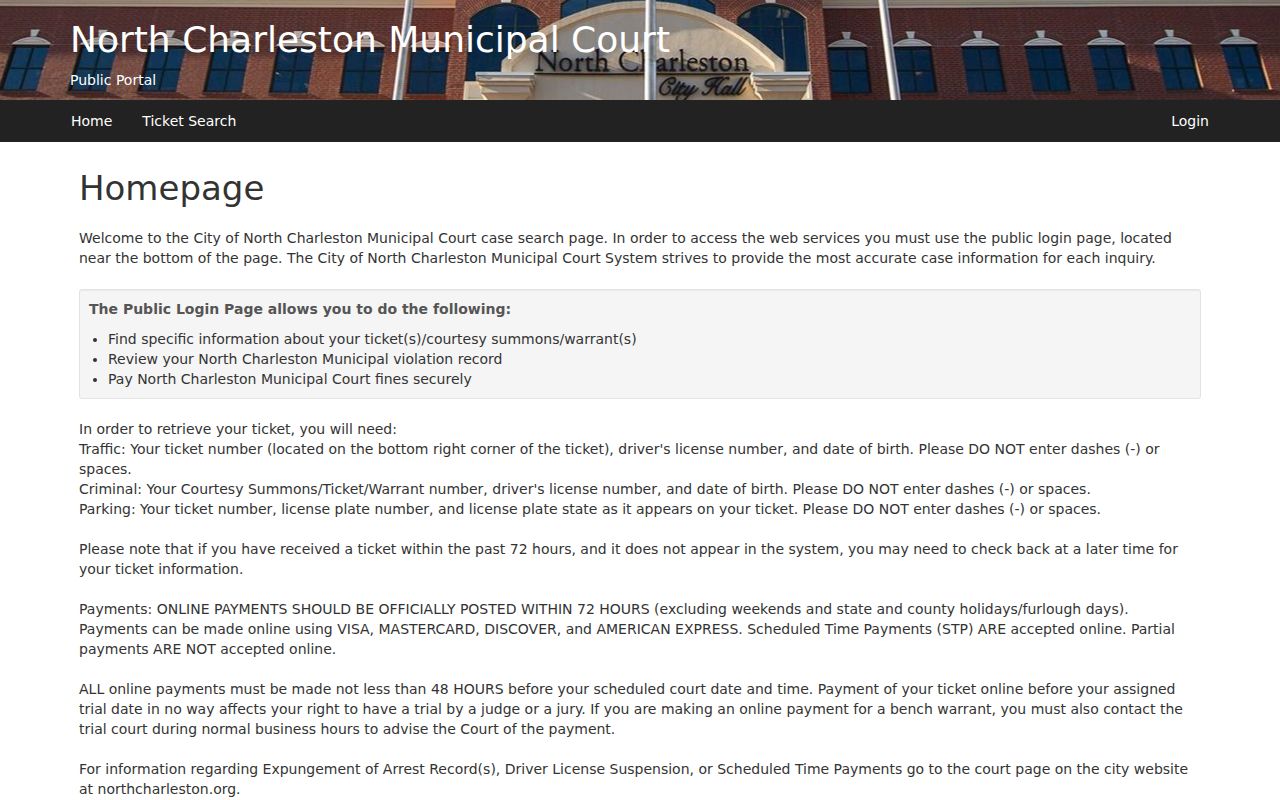
The portal's ticket and plate pathways reinforce the need to use a specific record identifier rather than treat it as a broad resident search.
Avoiding North Charleston Same-Name Matches
North Charleston's three-county footprint makes a same-name check more demanding. Search the surname and reasonable spelling variants, then compare a stable attribute. For property records, that can be the TMS, legal description, deed date, or a matched situs address. For court results, compare the party role, case date, and case type. An initial in a deed index or a changed tax mailing address is a research lead, not a final match.
Charleston County property cards list both a current owner and an owner as of January 1. Those values can differ after a transfer. The card can also show a deed book and page, sale date, sale price, legal description, parcel ID, tax district, and separate property and mailing addresses. Follow the parcel identifier to the recorded document only when the timing and legal description fit. For a whole street or an address-based trail, use the North Charleston Street Directory route instead of turning one name result into a neighborhood list.
North Charleston Vital Record Boundaries
South Carolina DPH Vital Records issues statewide birth, death, marriage, and divorce certifications, while the issuing county Probate Court retains the original marriage-license record. DPH central marriage filing begins July 1, 1950, and divorce reports begin July 1, 1962. A DPH divorce report is not the underlying decree. For an earlier marriage license, contact the Probate Court in the county that issued it.
Access is set by S.C. Code Ann. §§44-63-80, -84, and -86. Birth records become publicly viewable after 100 years and death records after 50 years. Before those thresholds, eligibility controls. DPH's documented paths include online service, phone, counter service, and mail. Its $12 nonrefundable search includes one certified copy when located, with $3 for an additional same-record copy. The expedited eligible-channel search is $17. Mail requests average four weeks according to DPH, while counter timing is not a promise.
The DPH birth-certificate request page illustrates the official channel and identification requirements for an eligible record request.
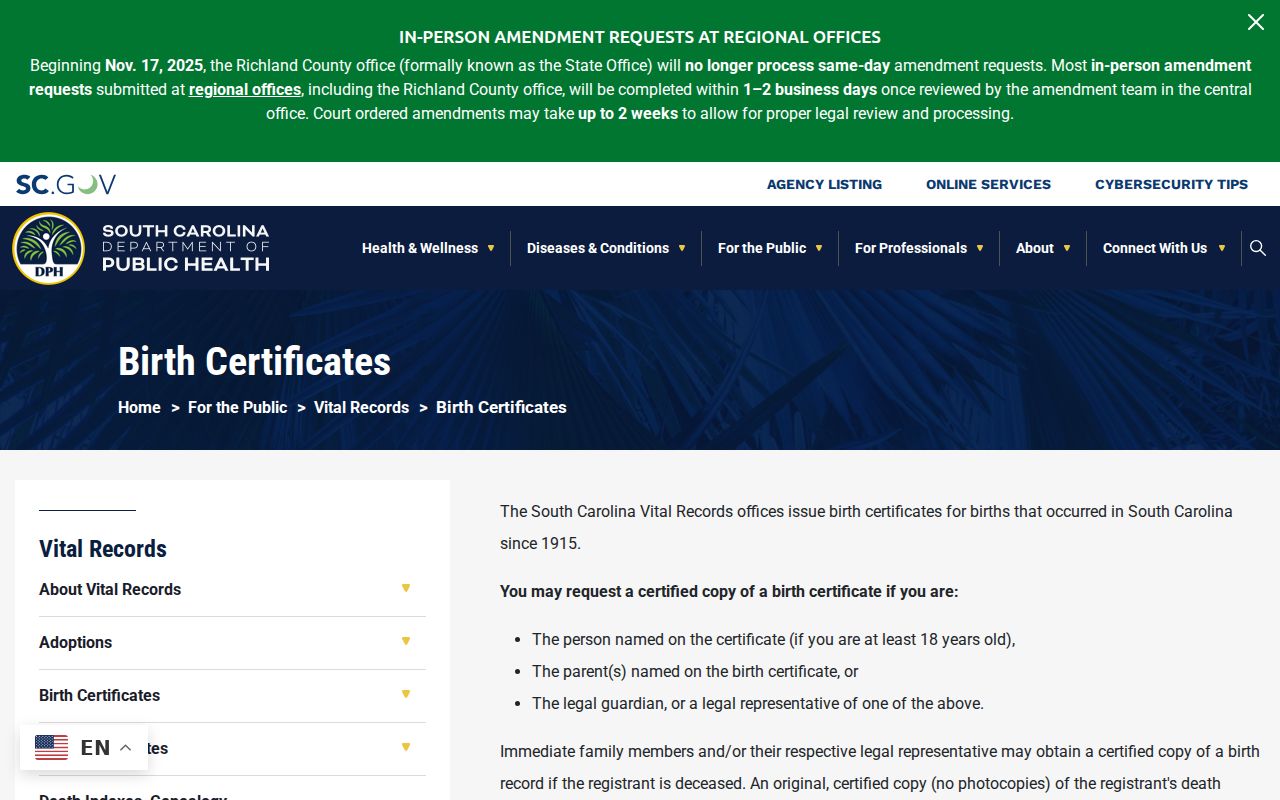
For historical work, DPH also provides death-index files for 1915 through 1967. A result is event evidence, not an automatic address confirmation.
Verify North Charleston Resident Records
A careful name search moves from a possible match to a record that can be checked independently. Start by writing down the name variation, likely county, known time period, and the one question that needs an answer. Use an address or parcel only when it is relevant. Then keep each record's limitations visible: a property owner may not be an occupant, and a court party may not be the same person as another party with that surname.
- Use the correct county property card or parcel viewer to anchor a name to a TMS, legal description, or recorded owner when property evidence is relevant.
- Search the applicable court index by case number or party name, checking role, date, and case type before saving a match.
- Use DPH or a county Probate Court for a life-event or estate question, following the stated eligibility and request channel.
- Ask the custodian for an identified public record by case number, document date, or parcel ID when an online index is incomplete.
- Docket
- A court's running list of case events, filings, and scheduled actions.
- Index and image
- An index points to a record; an image is the scanned document when the custodian makes it available.
- Certified copy
- A copy authenticated by the office that holds the original record, obtained through that office's procedure.
Note: Stop when records conflict, a category is protected, or the remaining evidence is only a name similarity.
North Charleston Estate and Affiliation Leads
For an heir question, a county Probate Court is the formal route. Public estate files can identify a personal representative, case filings, and other court-managed information, subject to protections for some matters. Choose the Probate Court by the decedent's domicile or property county. Dorchester's published instructions allow a public search by decedent last name or 13-character case number, then case expansion to review filings; documents display with a watermark unless purchased.
The South Carolina Treasurer's unclaimed-property search can be a potential heir lead, but a claim requires identity proof. Public affiliation can also be checked through Business Entities Online or the LLR Licensee Lookup. An entity filing, agent entry, or credential is not evidence of a current home address. Good Standing means the entity has not been terminated or dissolved, not that it is active in a particular place.
For a former classmate or a long-ago household, the CCPL South Carolina Room and Charleston Archive provide a different channel: directories, maps, microfilm, clippings, and research databases. Appointments for extended Archive research should be scheduled with the South Carolina Room. A historical result often needs a date, locality label, and a second source before it can support a family connection.
North Charleston FOIA Requests for Existing Files
When a known municipal record is not available through a public index, use the North Charleston FOIA portal for an existing record. The portal routes requests to departments including Building, City Council, Code Enforcement, GIS, Municipal Court, Planning and Zoning, Police, Public Works, and Finance. It is not a people-search screen. A useful request identifies an address, date span, project number, permit number, or case number and asks for a defined existing record.
South Carolina's Freedom of Information Act, S.C. Code Ann. §30-4-10 et seq., includes §30-4-30. On a written request, an agency must state its determination within 10 business days for records two years old or less and 20 business days for older records. If it grants access, the stated fulfillment periods are 30 calendar days after final determination, or 35 days for older records, subject to an allowed deposit. Exemptions and redactions remain part of the process.
City permit, inspection, and code records can identify a project, applicant, owner, contractor, or agent. They do not establish who lived at the address. Use the City Customer Portal's login channel where appropriate, or make a precise FOIA request when no public no-login search has been verified.
Protected North Charleston Addresses
Some gaps are intentional. South Carolina's Address Confidentiality Program, S.C. Code §16-25-130, has operated since 2025 and provides eligible participants a substitute government mailing address for dealings with state and local agencies and courts. It can explain a lawful mismatch in a record. The program does not erase information already public, and trying to work around a substitute address is unsafe and inappropriate.
Voter records have separate limits. Registration records are public for inspection under §7-5-410, but Social Security numbers are not open under §7-5-170, confidential source information stays protected under §7-5-186, and §7-5-321 provides an address, telephone, and email confidentiality path for qualifying electors. The state portal is designed for individual verification, not a broad name-by-address roster. DMV information is also not a public address directory under the federal Driver's Privacy Protection Act.
Commercial people-search products can be delayed, misattributed, duplicated, or stale. The record custodian, an authenticated copy, and statutory confidentiality rules control over a commercial profile. Report an apparent unredacted sensitive identifier to the custodian instead of repeating it.
Lawful Limits for North Charleston Resident Lookup
Public records do not create a current resident roster for a private address. They can omit adult household members, protected voters, Address Confidentiality Program participants, juvenile matters, sealed court files, utility customers, and other nonpublic information. A missing result may reflect a different county, a date gap, a protected category, or an index limitation. Confirm an identified record with the office that holds it.
Lawful use. Use official records for personal, lawful research such as family history, an estate question, or checking a record source. Do not use records to stalk, harass, intimidate, or harm anyone.