
North Charleston Previous Residents by Era
Previous residents research starts with the right record era and county. A current property card can seed a deed search. The recorded deed chain can reach former title holders. CCPL directories and census schedules can then test who was listed at the address in a particular period. The evidence changes with the source: deeds document transfers, while a reverse directory may place a listed occupant at a street number. Neither record type alone answers every past-resident question.
| Source | Years or cutoff | Where held | What it can show |
|---|---|---|---|
| Charleston County ROD online index | 1978 to current notice; images from February 1997 | Online Document Search | Parties, instrument, record date, book or page, and in-range images |
| Charleston property-card transfers | Basic online transfers complete to 1991 | Auditor property card and Card Image | Current and January 1 owner, sale and deed clues |
| Charleston historic deed books | Paper 1719 to 1960; film or microfiche 1960 to 2005 | ROD counter and historical-book project | Earlier conveyances by legal description or book and page |
| Berkeley ROD | Index and images from July 1, 1983; some deed images from January 1974 | Berkeley ROD portal and office | Land records for Berkeley County parcels only |
| CCPL directories | 1782 to present with gaps; street listings from 1890 onward | CCPL online, microfilm, and books | Listed names and address evidence in available years |
| Federal census | Public releases under the 72-year schedule | NARA and CCPL database access | Household composition and period details |
Charleston County is not the automatic choice for every North Charleston address. Berkeley and Dorchester parcels have their own ROD and assessment systems. Confirm the county from the parcel card first. For Dorchester, an official online deed cutoff was not found in the research, so the St. George land archive library and ROD staff are the documented fallback.
Start North Charleston Records by Parcel
A parcel identifier is more dependable than a modern postal number when tracing past residents. For a Charleston County address, use the Property Record Cards to capture the TMS, situs, legal description, subdivision, plat book or page, current owner, owner as of January 1, deed book or page, and sale or deed date. The card separates a physical property address from a tax mailing address. A mailing contact can be a trust, manager, post office box, or later owner, so it does not prove residence.
The Charleston County property-card search appears below. It gives a North Charleston previous residents search the parcel key and deed reference needed for the next stage.
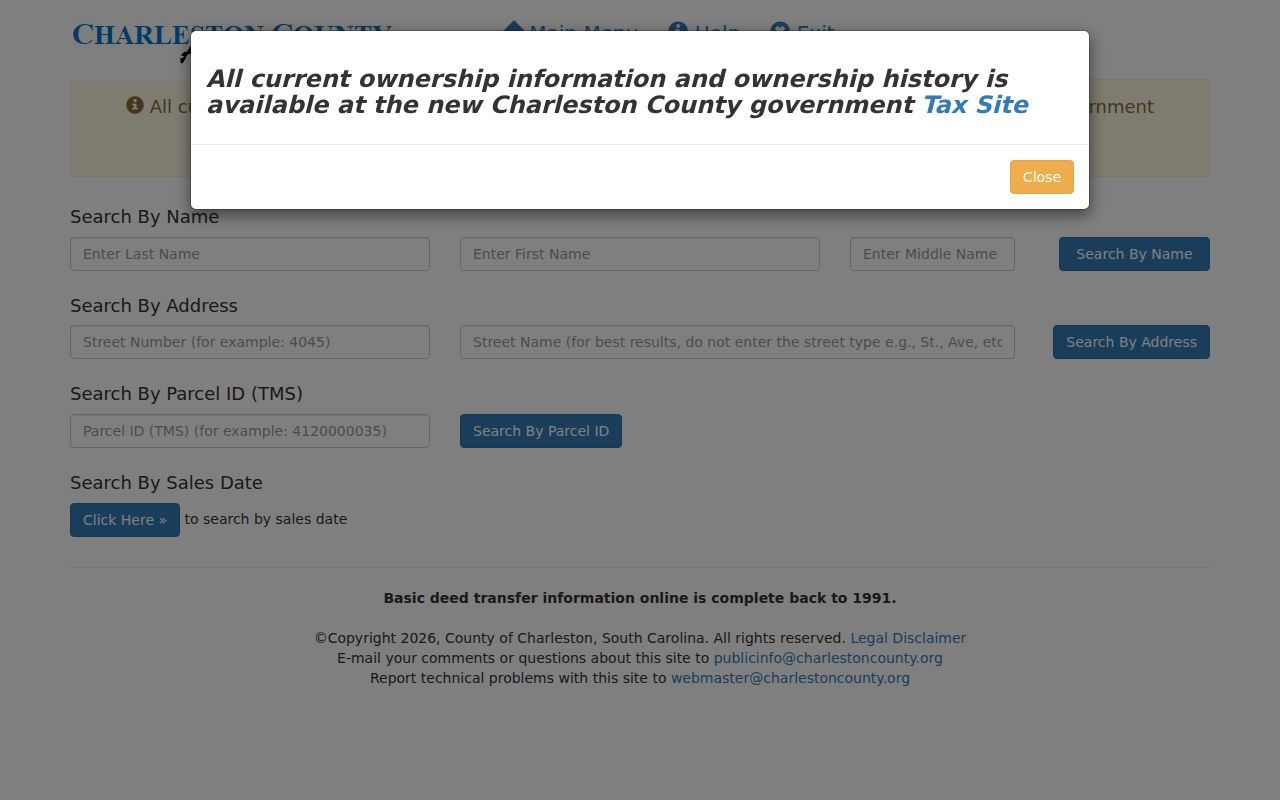
Search by address, name, parcel ID, or sales date where the portal permits it. For street searching, Charleston County says to omit the street type and to spell out numeric street names before trying a numeral. Save a copy of every card consulted because the current owner and January 1 owner may differ after a transfer.
Trace North Charleston Records in Deeds
The address-to-deed path is current parcel card to acquisition deed to former owner, then back again. The Charleston County ROD Document Search supports name and date, type and date, book and page, tracer, and all-fields approaches. Start with the book and page reported on the property card when available. Record the party roles, instrument type, record date, legal description, and prior-reference language before moving to an earlier transfer.
- Confirm the parcel county and capture TMS, situs, legal description, plat reference, and current deed citation.
- Open the cited acquisition deed in that county’s Register of Deeds index.
- Record the grantor, who transferred the property, and the grantee, who received it, with each reference.
- Search the former owner as a grantee to locate that person’s earlier acquisition, using the same lot, block, subdivision, or plat details.
- When the online range ends, continue at the same county ROD through its counter, film, microfiche, paper books, or archive channel.
- Grantor and grantee
- The grantor transfers an interest; the grantee receives it. Their roles help turn a recorded transfer into a backward title trail.
- Chain of title
- A sequence of recorded transfers for the same parcel, checked by legal description rather than surname alone.
- Legal description
- The lot, block, subdivision, plat, or metes-and-bounds description used in land records. It survives address changes better than a postal number.
Note: A recorded transfer identifies a property interest, not necessarily a person who occupied the address during that period.
North Charleston Records Change by County
The online boundary is a major part of a North Charleston backward address search. Charleston County’s public notice gives deed and mortgage index data from 1978 and images from February 1997. Its ROD reports physical access to recorded documents from 1719 to 1960 and film or microfiche for 1960 to 2005. Berkeley provides free online search and copies for records from July 1, 1983 forward, with some deed images from January 1974 when the book and page are accurate.
Dorchester provides a property deed search and a public land archive library, but the official research did not verify the online beginning year. Do not fill that gap with another county’s cutoff. Call, email, visit the counter, or ask the ROD which book, film, or image channel reaches the transfer year at issue. The county office is also where a formal copy question belongs.
North Charleston Records at CCPL
CCPL’s historic-property research guide makes the local fallback concrete. It identifies city directories from 1782 to the present, an 1840 cross-reference, street listings from 1890 onward, maps from the 1670s to the 1990s, tax books, historic photographs, and archival paths. Ask the South Carolina Room or Charleston Archive for help with a specific year, street, directory section, map, or historic-property call number. The Archive is closed-stack, so advance planning matters.
CCPL’s house-history guide is pictured here. It points North Charleston previous residents research toward the local collections that remain useful after a title index or web search ends.
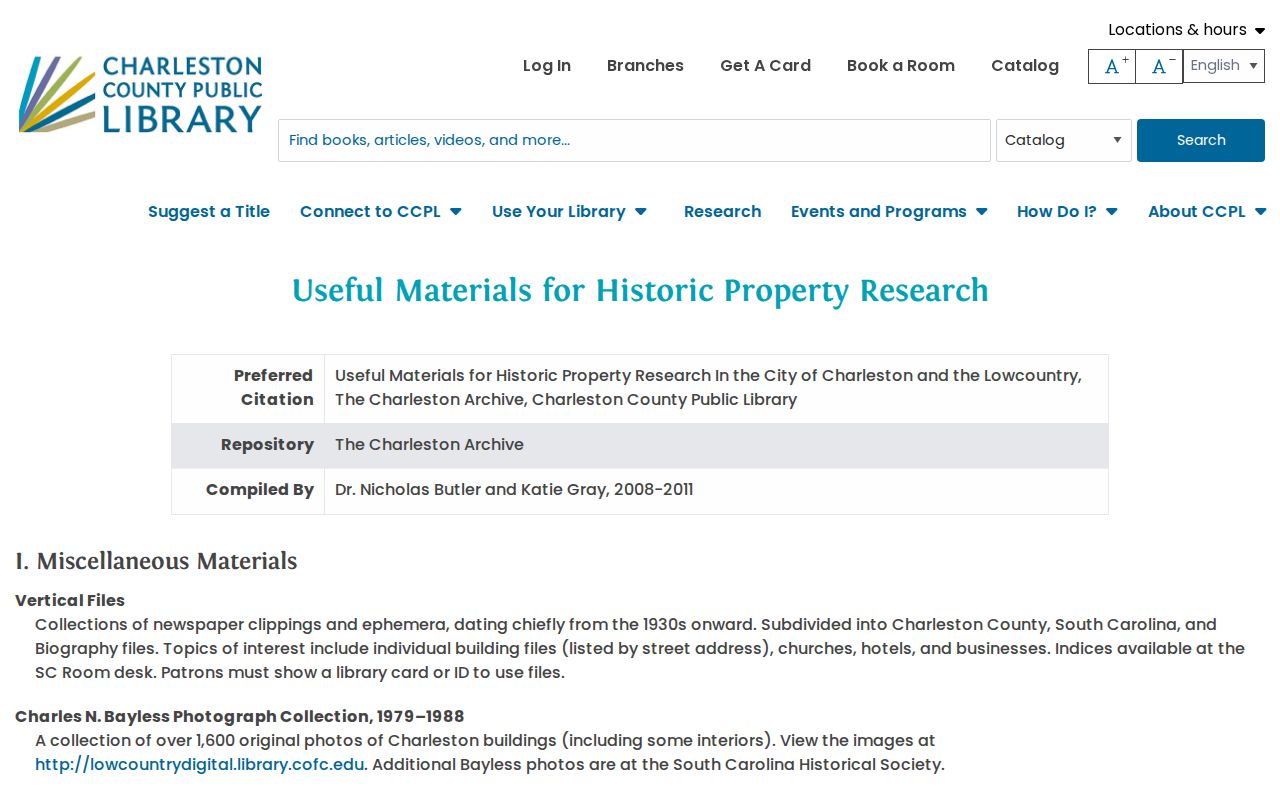
The guide is especially useful when an old deed uses a lot or plat reference rather than the current street address. Compare that legal description with maps, directory street listings, and adjacent names before deciding two addresses represent the same place.
Pair North Charleston Records With Census
Previous residents are often found at the household level only after the title trail produces a likely period. CCPL explains that reverse or street listings exist in the exceptional 1840 directory and from 1890 forward. A street listing is arranged by address, then listed occupant. Search that entry, then the alphabetical directory, to gather a spelling, initials, occupation abbreviation, spouse or widow notation, or other period clue that may appear in a given volume.
CCPL’s City Directories holdings are shown below. The library notes that Navy Base and North Charleston addresses can appear in separate suburban sections in 1940s and 1950s editions, so do not stop after checking the main Charleston sequence.
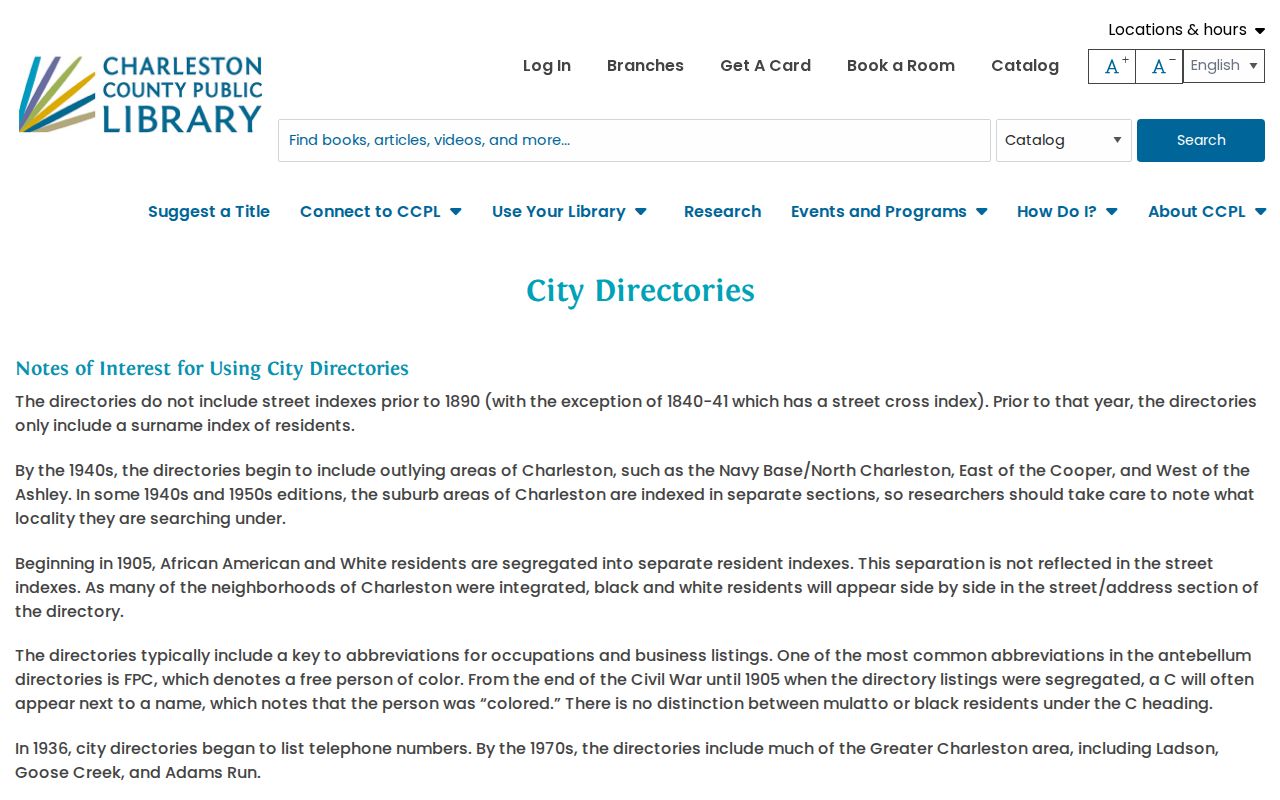
Pair a directory year immediately before or after an available federal census. Census records from 1850 onward name household members, while the directory can provide an address between census years. First verify address continuity. A vanished entry can reflect a move, death, service, publisher gap, altered spelling, or changed coverage.
Address flow: deed date to likely household period, directory street entry to a name, alphabetical entry to detail, then the nearest released census for household corroboration.
North Charleston Directory Sections Matter
Directory material predates the present municipal boundary. North Charleston incorporated in 1972, and older sources may use Charleston, Charleston County, Charleston Neck, Navy Yard, Navy Base, St. Philip Parish, or St. James Goose Creek Parish. The North Charleston name itself is tied to a 1912 development scheme. Search those period labels as well as the modern address when a household trail seems to disappear.
CCPL’s directory collection catalog is shown below. It helps identify available formats and years before a North Charleston previous residents search moves to the South Carolina Room or a licensed digital collection.
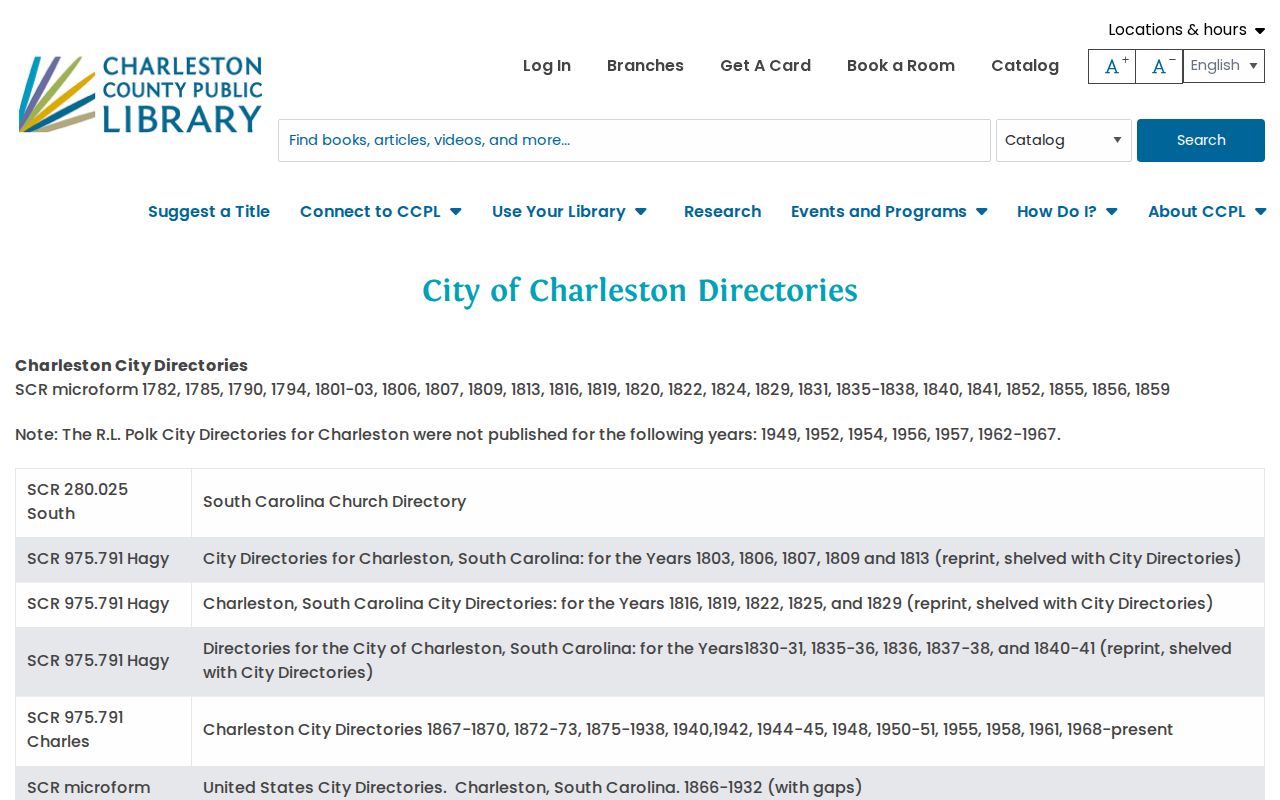
CCPL reports missing R. L. Polk years, including 1949, 1952, 1954, 1956 to 1957, and 1962 to 1967. An absent name in one of those gaps is not negative evidence. The separate North Charleston Directory Book covers the collections and entry-reading method in more depth.
North Charleston Records, Maps, and Permits
Historic maps, plats, and the legal description bridge address changes. CCPL’s map collection covers the 1670s through the 1990s, while the Charleston County Parcel Viewer includes building-footprint and imagery layers from later years. CCPL documents early street renumberings in peninsular Charleston, including a project from 1884 to 1886. That is not proof of a blanket North Charleston renumbering. Use it as a cue to compare maps, plats, and adjacent names.
For a known address and project period, the City’s FOIA portal can route a focused request to Building, Code Enforcement, Planning and Zoning, GIS, or another identified department. Permit chronology may bracket construction or alteration, but a named applicant or agent is not automatically an occupant. Probate files may provide an official estate path when a transfer trail reaches a death; county Probate Courts, not the circuit clerk, retain estate and marriage-license materials.
North Charleston Previous Residents Have Limits
Past resident records should be read with care. A parcel owner, a tax mailing contact, and a directory occupant are three different forms of evidence. Public records do not provide a complete list of every past household member, and protected, sealed, juvenile, utility, delivery, or DMV address information is not a house-history source. South Carolina’s Address Confidentiality Program creates lawful substitute-address situations that researchers must respect.